Academic Departments
Close
CtrlK
Sri Sri College of Ayurvedic Science & Research Hospital, Sri Sri University
Search doctors, departments...
Home About Us Online Consultation NCISM Mandatory Contact Us
Login Register

Agada Tantra & Vidhi Vaidyak

Ayurvedic Toxicology • Forensic Medicine • Medical Jurisprudence

Student Capacity: 100
Consult a Doctor Online NCISM Compliant
Department Overview

Toxicology & Forensic Medicine in Ayurveda

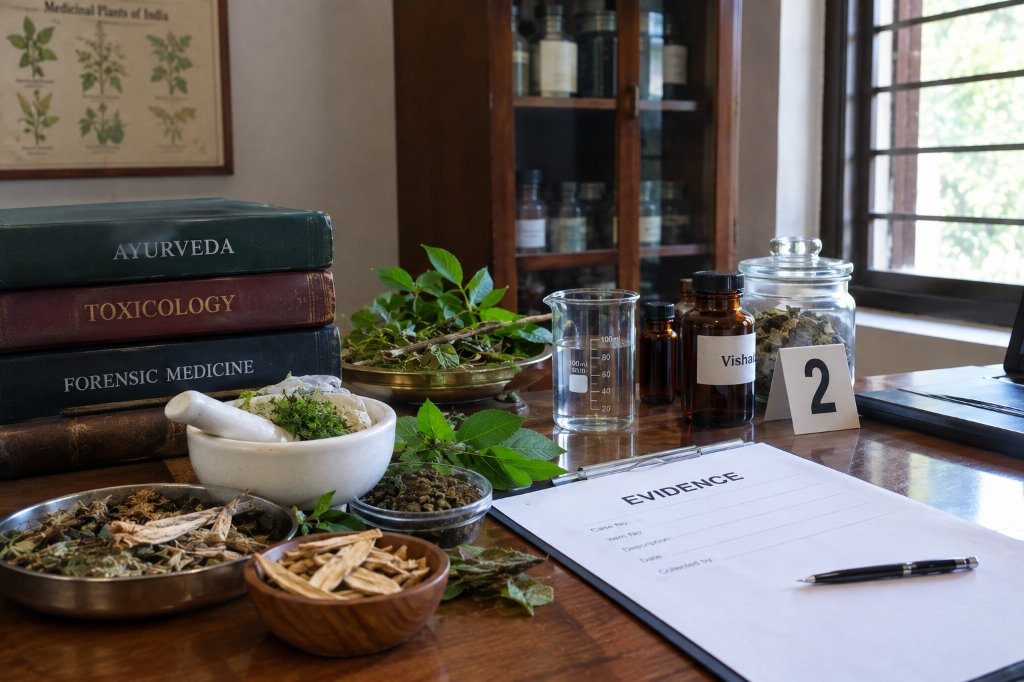
Agada Tantra deals with the study of poisons, their action, clinical manifestation, and the diagnosis and management of acute, chronic, and cumulative toxicity.

Quick Fact
Did you know?

"Agad Tantra, the Ayurvedic science of toxicology, is one of the oldest documented forensic sciences! Ancient texts describe over 80 types of poisons and their antidotes, including snake venom treatments still studied today."

It covers natural toxins (plants, metals, animals like snakes/scorpions), artificial poisons, and environmental toxicity. The department bridges the gap between traditional Ayurvedic toxicology and modern forensic medicine (Vidhi Vaidyak), preparing students for medico-legal responsibilities, medical ethics, and the legal aspects of medical practice.
Key Focus Areas
  • Toxicology Management: Treating poisoning from animate (snake, insect) and inanimate sources.
  • Forensic Medicine: Understanding injuries, death analysis, and legal procedures.
  • De-addiction: Management of acute and chronic drug dependence and withdrawal.
  • Medical Jurisprudence: Medical ethics, Consumer Protection Act, and legal duties of a doctor.
Forensic Science
Department Highlights
  • Forensic Museum
  • Medico-legal Training
  • Poison Management
  • Law & Medicine Interface

Vision

To bring law and medicine together to prepare medical students for their medico-legal and social duties. To provide sufficient knowledge and skill to handle poisoning cases and train scholars in forensic medicine fields.

Mission

  • Become a benchmark for quality Medico-legal and Medical Jurisprudence education.
  • Produce graduates who are "first contact physicians" aware of ethics and legal acts.
  • Provide services of judicial medical officers and forensic pathology.
  • Exceed expectations of students, patients, and law enforcement agencies.
Academic Goals

Objectives & Outcomes

Learning Objectives
  • Understanding medical ethics and various acts governing practice.
  • Learning identification of poisonous vs. non-poisonous substances.
  • Active involvement in OPD and De-addiction units.
  • Participation in seminars, court visits, and FSL visits.
Student Outcomes
  • Development of Ethical and Legal Awareness.
  • Capability to act as a "first contact physician" in poisoning cases.
  • Ability to make logical deductions in criminal and medico-legal problems.
  • Comprehensive grasp of medico-legal responsibilities.
Legal Medicine
Practical Training

Experiential Learning

Students gain hands-on experience through practical demonstrations, field visits, and museum studies.

Field Visits

Visits to Courts and Forensic Science Laboratories (FSL) to understand legal procedures.

Identification

Specimen identification: Poisonous snakes, plants, and toxic compounds.

Forensic Study

Study of weapons, injury patterns, and death investigation reports.

Documentation

Maintenance of practical logbooks for daily medico-legal activities.

Infrastructure

Department Museum & Library

Extensive Collection of Forensic Artifacts and Toxicology Specimens

52

Charts

50

Weapons

100

Specimens

24

Models

Collection of weapons for studying mechanical injuries and medico-legal classification of wounds.

  • Revolver & Gun Shot items
  • Knife, Dagger, Scalpel
  • Axe, Hatchet, Chopper
  • Sword (Double edged), Bhala
  • Iron Rod, Hammer, Chain
  • Rope (Nylon), Wire
  • Sickle, Blade, Scissor
  • Trishul, Bow and Arrow
  • Broken Glass, Ice Pick
  • Police Lathi, Brass Knuckles
  • Bike/Cycle Tyres
  • Screwdriver, Saw

Natural Poisons
  • Plants: Vatsanabha, Kupilu, Dhatura, Bhallataka, Gunja, Ahiphena, Jayapal, Arka, Snuhi.
  • Animals: Cobra, Krait, Viper (Pit/Russell), Scorpion, Sea Snake, Honey Bee, Hornet.
Chemical & Artificial
  • Metals: Arsenic, Mercury, Lead, Copper.
  • Chemicals: Acids (HCL, H2SO4, Nitric), Kerosene, Petrol, Alcohol (Methyl/Ethyl).
  • Drugs: Diazepam, Paracetamol, Barbiturates.
  • Insecticides: DDT, Begon, Mosquito Repellent.

  • Hanging (Ligature mark, Scene)
  • Strangulation & Throttling
  • Stab Wounds & Cut Throats
  • Gun Shot Wounds (Entry/Exit)
  • Burns (Degrees of Burn)
  • Rigor Mortis & Cadaveric Spasm
  • Putrefaction & Marbling
  • Mummification
  • Fingerprint Types
  • Blast Injuries

Collection including standard texts on Medical Jurisprudence, Toxicology, and Ayurvedic Samhitas.

Key Titles:
  • Modi's Medical Jurisprudence & Toxicology
  • Parikh's Textbook of Medical Jurisprudence
  • Agada Tantra (Various Authors)
  • Forensic Toxicology Principles
  • Charaka & Sushruta Samhitas
  • Vyavaharayurveda And Vidhivaidyaka
  • The Essentials of Forensic Medicine (Reddy)
Our Team

Meet Our Faculty

Experts in Agada Tantra & Forensic Medicine

Teaching Faculty
Dr. Debasish Satpathy
Associate Professor
Teacher Code: 1001721
Dr. Moumita Tewari
Assistant Professor
Teacher Code: 1002128
Non-Teaching Staff
Free Assessment

Discover Your Prakriti

Understanding your unique mind-body constitution (Prakriti) is the foundation of personalized Ayurvedic treatment.

Take our comprehensive Prakriti Assessment Quiz to discover whether you are Vata, Pitta, or Kapha dominant. Get personalized diet, lifestyle, and wellness recommendations based on your results!

Vata

Pitta

Kapha

5-minute quiz • Instant results

24×7 Emergency +91-7894424564 WhatsApp Us +91-7008144320